Marketing on Amazon
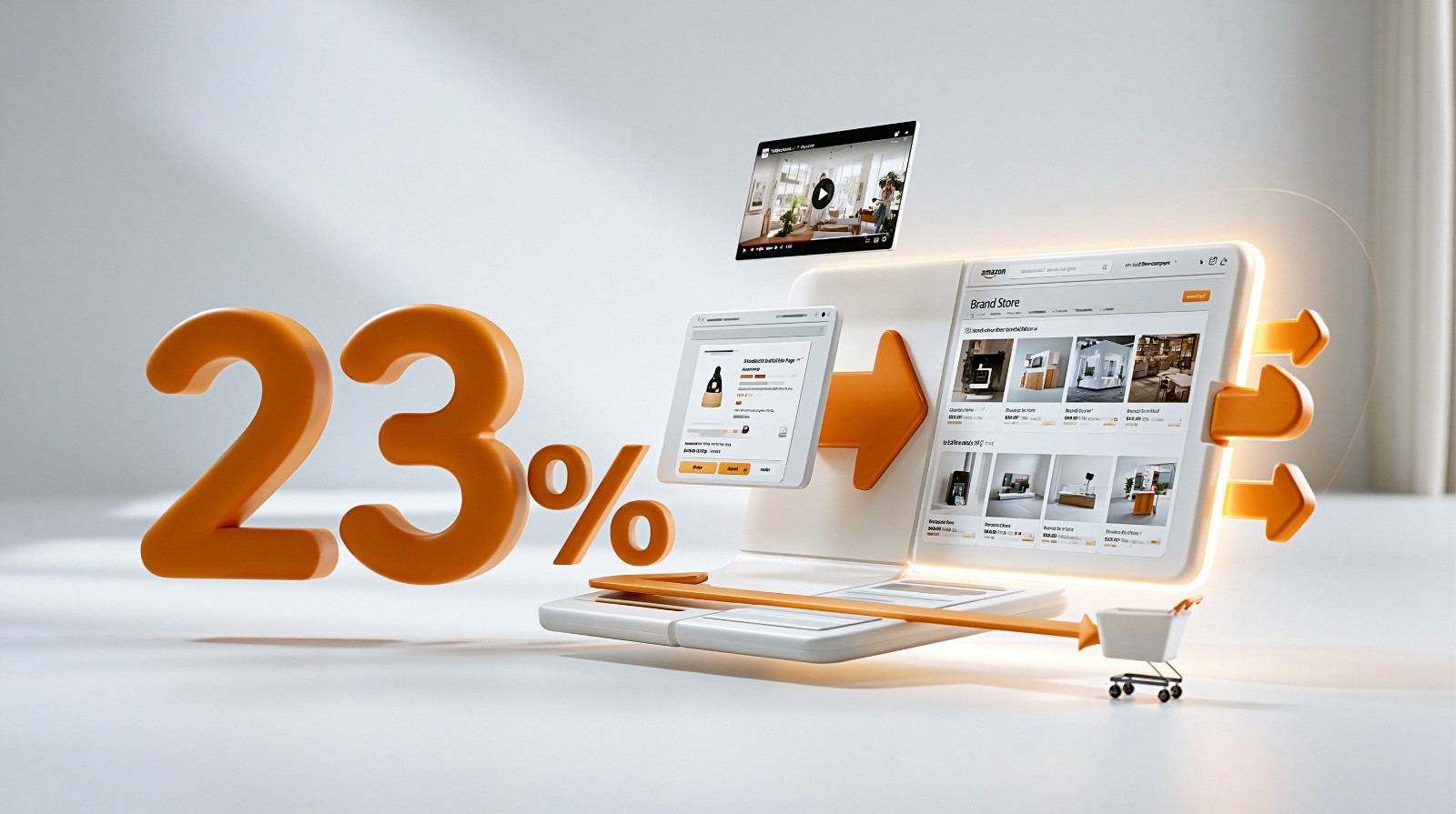
Brand Store increases conversion of video campaigns on Amazon. Data shows a 23% advantage
Last updated: 12.08.2026
Video alone in search results has stopped being enough. A brand can capture a user's attention, show a product in motion and build interest, but the outcome of a campaign is also determined by where the ad leads.
Many advertisers direct traffic from Sponsored Brands Video straight to the product page. This is the shortest path to the price, reviews and the buy button. However, Amazon data shows that a Brand Store can leverage the interest built by video content more effectively.
“Sponsored Brands Video campaigns with a Brand Store as the landing page achieved a 23% higher conversion rate on average than campaigns directing to product detail pages.”
Source: Amazon Internal, 2024
In practice, this means that engaging a customer in a broader brand context can yield a better sales result than directing them immediately to a single listing.
Table of contents:
What does a 23% increase in conversion mean?
Why can a Brand Store sell more effectively than a Detail Page?
What does the path from ad to basket look like?
How to prepare Sponsored Brands Video for sales?
What risks need to be considered?
Video is no longer just a branding tool
What should brands do?
FAQ - Frequently Asked Questions
This article takes 5 minutes to read.
What does a 23% increase in conversion mean?
Sponsored Brands Video campaigns leading to a Brand Store achieved a 23% higher conversion rate on average than campaigns directing to a Detail Page. For brands, this represents an opportunity to generate more orders from the same advertising traffic. On an annual scale, such a difference can influence the utilization of the Amazon Ads budget, ROAS and the profitability of selling on Amazon.
Check: Amazon Ads management service
The result also shows that the landing page should not be chosen solely as a technical element of campaign configuration. It is part of the entire purchasing journey and one of the factors influencing whether interest will result in a purchase.
Why can a Brand Store sell more effectively than a Detail Page?
A Brand Store gives a brand greater control over what the user sees after clicking the ad.
Less space for competing offers
On a product page, the user can see cheaper substitutes and other products competing for their attention. In a Brand Store, they navigate within the environment of a single brand. As a result, contact with the ad is not immediately interrupted by further offers and comparisons. The brand can retain the user's attention longer and direct it to its own products, categories and sales arguments.
Broader product context
Video arouses interest, but is usually unable to convey all the information needed to make a decision. A Brand Store can expand on the ad's message. The user sees not only a single product, but also:
Other variations
Related products
How to use it
Brand values
Broader category context
Information helping to choose the right solution
Such an approach can be of particular importance for premium products and products requiring additional explanation.
A coherent connection of ads, content and the presentation of the entire portfolio is of particular importance for brands developing their own sales on Amazon. See what Amazon sales management for manufacturers looks like.
Greater trust in the brand
A customer arriving at a Brand Store sees an organized space dedicated to a single brand. They can learn about its offer, communication style and broader product applications. Thanks to this, the purchasing decision is not based solely on price and a single listing. The user receives more information that can reduce their doubts and build trust.
Continuation of the story started in the ad
A video can show a problem, product application or the effect of its use. A Brand Store allows this story to be expanded and guides the user to the appropriate product. This involves a brand immersion mechanism, i.e. dipping into the brand's world. The customer does not land on a digital shelf with a single product, but in a space resembling a brand boutique. Such a path can reduce the risk of a quick exit from the page. The user has more reasons to stay, explore the offer and proceed to purchase.
What does the path from ad to basket look like?
The effectiveness of this model relies on the consistency of the subsequent stages. A video ad first captures attention. Motion, showing the product in use and a clear message build interest and purchasing intent. After clicking, the user arrives at the Brand Store. There, they should see an expansion of the same argument that appeared in the video.
If the ad shows a solution to a specific problem, the Brand Store should immediately confirm this promise. The customer should not have to search for the product or wonder where they landed. The final stage is proceeding to the correct offer and adding the product to the basket. The Brand Store is meant to facilitate this choice, not add further obstacles.
How to prepare Sponsored Brands Video for sales?
The campaign outcome depends not only on the choice of the landing page. The design of the video content itself is also crucial.
Show action from the first second
The beginning of the video should quickly attract attention. Instead of black frames, a long intro or a static logo, it is worth showing the product in motion straight away. The user should quickly understand what they are watching and why the product might be useful to them. Ideally, the video should show the solution to the problem within the first half of the footage.
Add text overlays
Many video ads start without sound. The most important arguments must therefore also appear on the screen. Captions should be short, legible and linked to the image. Their task is to convey the main benefit or function without the need to listen to a voiceover.
Maintain consistency between the video and the Brand Store
The video content and the landing page should form a single communication path. If the video shows a specific function, application or problem, the Brand Store should direct the user to a section that expands on precisely that topic. A lack of consistency can weaken interest. The user clicks the ad with a specific expectation, and upon landing on the page, does not find the information they were looking for.
Focus on a length of 15-30 seconds
The content should convey the most important information without overwhelming the audience. A 15-30 second format allows information to be combined with a dynamic product demonstration. It gives enough time to present the problem, solution and a call to action.
Place the logo at the end
The logo can close the video and remind the user of the brand they have just encountered. First, however, it is worth showing the product and its application. The brand appearing at the end then acts as a summary of the message rather than a delay before presenting the benefits.
What risks need to be considered?
A higher average conversion rate does not mean that every campaign leading to a Brand Store will automatically achieve a better result.
Higher CPC cost
Sponsored Brands Videos compete for highly visible positions in search results. For this reason, campaigns may experience a higher CPC. Therefore, higher conversion should be analyzed alongside traffic costs and ROAS. The number of orders alone does not give a complete picture of profitability.
Overloaded Brand Store
A Brand Store can only increase conversion if it helps the user make a decision. Too many sections, products and messages can have the opposite effect. The customer may feel lost and leave the page. The layout should be simple, clean and lead to a specific action.
Poor mobile optimization
A large portion of users view ads and browse offers on their phones. If the Brand Store is unreadable on a smaller screen, the potential built by the video may be lost. Graphics, captions and section layouts must also work on mobile devices.
Amazon requirements
Amazon strictly evaluates the quality of advertising materials. Lacking Brand Registry or using prohibited elements can lead to an ad rejection. Before publishing, compliance of the content with the platform's requirements must be verified.
Video is no longer just a branding tool
In previous years, video formats were often used primarily to build brand awareness. Sales were meant to take place later, on the product detail page.
Amazon data shows a shift in this approach. Sponsored Brands Videos connected with a Brand Store can perform a sales function and support performance efforts. The development of advertising formats fits into broader changes in Amazon Advertising, which also include the increasing use of AI and campaign automation. Video captures attention and shows the product. The Brand Store expands on the arguments, builds trust and helps choose the right offer.
Compared to standard display ads, this combination can deliver a higher ROAS, especially for products requiring demonstration or additional explanation.
What should brands do?
The first step should be to analyze current Sponsored Brands Video campaigns and their landing pages.
Redirect selected campaigns to the Brand Store
It is worth considering directing traffic to the Brand Store, especially for bestsellers, premium products and offers requiring broader explanation. This is not about automatically moving all campaigns. Each case should be evaluated based on the product, user intent and the quality of the Brand Store.
Apply an Action-First approach
The video should immediately show the product, its use or a solution to a problem. A long introduction takes up time that could be used to present a sales argument.
Test variations
It is worth comparing different versions of content, for example:
15 and 30 seconds
lifestyle scenes and feature demonstrations
different video openings
Detail Page and Brand Store as landing pages
A/B testing allows you to verify which format works best in a given category and for a specific audience.
Ensure technical quality
Before launching a campaign, you should:
remove black frames
add clear captions
check the look of the content on a phone
maintain consistency between the video and the Brand Store
ensure the ad meets Amazon's requirements
use the logo to close the message
h2 id="96">What does this mean?
The 23% result shows that the effectiveness of Sponsored Brands Video campaigns does not depend solely on the video itself. Equally important is where the user lands after clicking and whether the landing page continues the ad's message.
A Brand Store gives a brand the space to show a wider range of products, limit the presence of competing offers and expand on arguments that cannot fit into a short video clip.
If the store is clear, consistent with the ad and optimized for mobile devices, it can guide the user to a purchase more effectively.
FAQ - Frequently Asked Questions
Is it better to direct Sponsored Brands Video to a Brand Store or a product page?
According to Amazon data, Sponsored Brands Video campaigns directing users to a Brand Store achieved a 23% higher conversion rate on average than campaigns leading directly to a Detail Page. However, this does not mean that a Brand Store will be the better solution for every campaign – the choice of landing page should take into account the product, user intent and the quality of the prepared brand store.
Why can a Brand Store increase video campaign conversion?
A Brand Store allows you to expand on the message started in the ad, show a wider range of products, variations and applications, and limit the presence of competing offers. As a result, after clicking the ad, the user remains within the environment of a single brand and receives more information needed to make a purchasing decision.
Should every Sponsored Brands Video campaign be directed to a Brand Store?
No. In the article, we recommend considering the Brand Store primarily for bestsellers, premium products and offers requiring a broader explanation. Each case should be evaluated individually based on the product, user intent and Brand Store quality.
How to prepare an effective Sponsored Brands Video?
The content should quickly show the product in action and present its most important benefit or application. It is worth using clear text overlays, ensuring consistency between the video and the landing page, and checking how the video presents on mobile devices.
How long should a Sponsored Brands Video ad be?
The article recommends a format of 15–30 seconds. This length allows you to present the problem, show the product as the solution and encourage the user to take further action without overloading them with too much information.
How to connect Sponsored Brands Video with a Brand Store?
The ad and the Brand Store should form a coherent communication path. If the video shows a specific function, application or solution to a problem, after clicking, the user should arrive at a place that directly expands on that same argument and makes it easy to find the right product.
Does a higher conversion rate mean better campaign profitability?
Not always. Sponsored Brands Videos can generate a higher CPC, so the conversion rate should be analyzed alongside traffic costs and ROAS. The number of orders alone is not enough to evaluate campaign profitability.
How to check if a Brand Store performs better than a Detail Page?
It is worth testing both landing page options and comparing campaign results. The article recommends A/B tests covering, among other things, Brand Store and Detail Page, as well as different lengths and versions of video content.
Go2Market