Sales on Amazon
Amazon's hidden costs. Why you are calculating a non-existent profit without a P&L per SKU?
Last updated: 13/07/2026
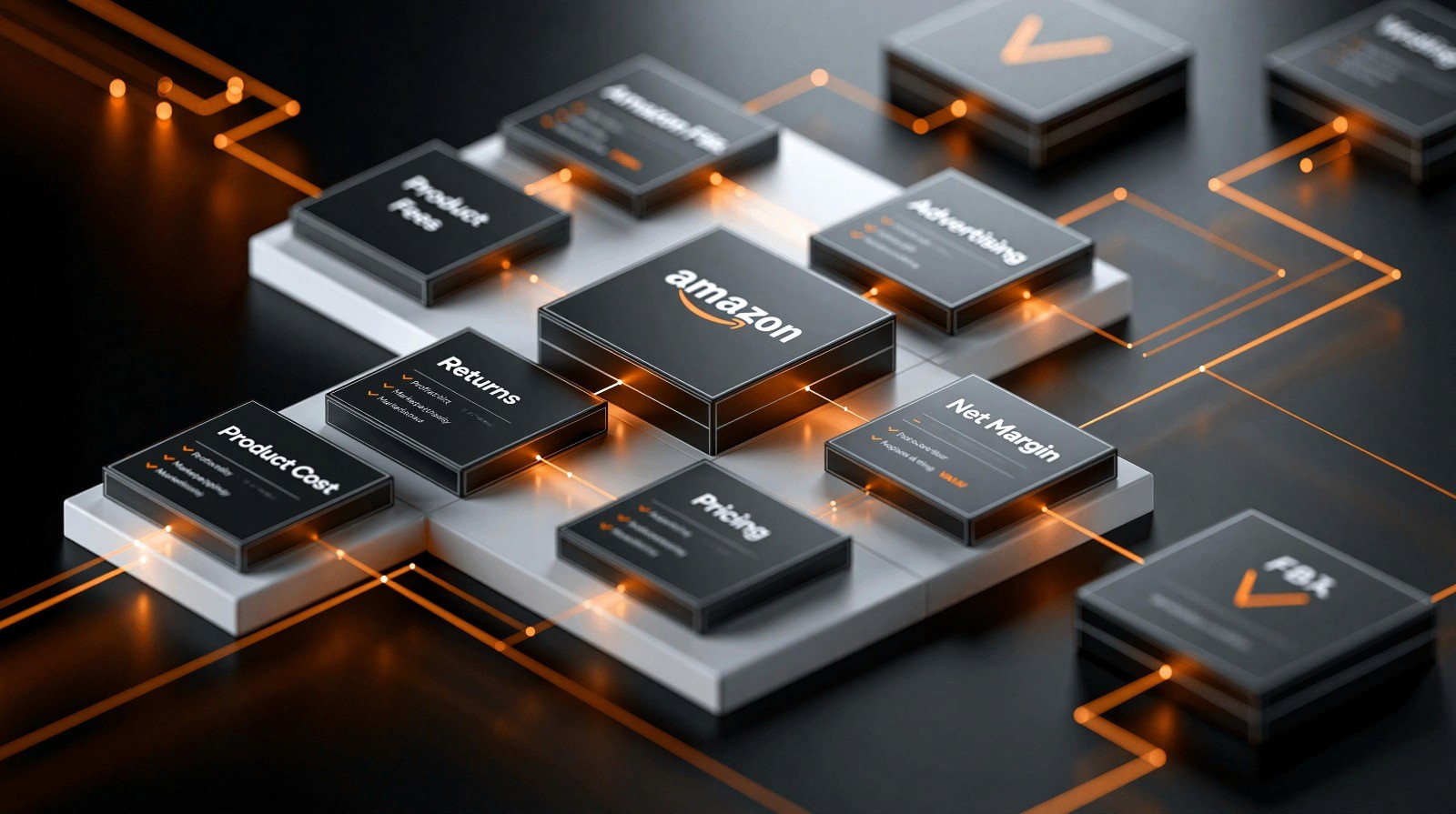
Amazon commission is just one element of the bill. If a brand wants to evaluate the actual profitability of sales, it should look at the full Profit & Loss per SKU, i.e. check how much money is left after deducting all costs related to product, logistics, advertising, account management and regulatory requirements. Only such a picture shows whether a product is actually making money, or just generating sales that look good in reports.
Table of contents:
Purchase price is just the beginning of expenses
Amazon commission does not tell the whole story about margin
FBA can make selling easier, but it must be factored into the equation
PPC advertising as an essential expense to launch sales
Customer returns can heavily impact the financial result
Storage quietly drains the budget
Inbound logistics do not end with transport to the warehouse
Maintaining sales on the marketplace is also an operating cost
Compliance in the European market is increasingly determining results
Real profitability begins after deducting all costs
The greatest dangers for margin hide in superficial calculations
Summary
FAQ - Hidden costs of Amazon
You can read this article in 5 minutes.
Purchase price is just the beginning of expenses
Financial analysis should begin by determining the total cost of the goods along with their delivery, looking more broadly than just the amount on the invoice from the manufacturer or supplier. Calculations must take into account transport from the contractor, customs duty, import VAT, preparation of goods for trade, as well as potential labelling and repackaging. Each of these factors reduces the margin before the goods even reach the buyers.
Limiting the calculation solely to the purchase price results in a distorted picture of profitability. On paper, profitability may look favourable until invoices for logistics, product preparation and the process of launching it on the market appear in the statement.
Amazon commission does not tell the whole story about margin
The Amazon platform charges a fee for each completed transaction. Its level is determined by the product category and usually falls within the range of 8% to 15% of the sales amount. This rate is calculated on the total sum paid by the customer, which means it covers the entire value of the purchase, not just a selected part of the item's price.
This is a significant expense, but it should not be the main focus of the analysis. Basing the decision to debut on the Amazon platform solely on the commission rate leads to ignoring many other charges that can actually determine the final result.
FBA can make selling easier, but it must be factored into the equation
Using the Fulfillment by Amazon program imposes an obligation to include fees for storage, picking orders, packing and delivering the parcel to the buyer in the costs. FBA expenses are determined mainly by the dimensions, weight and type of goods, as a result of which two SKUs with a similar retail price can generate completely different profitability.
A light and small item is able to maintain a satisfactory margin after sale. On the other hand, a larger or heavier product will start generating logistics losses even before marketing, returns or storage costs are taken into account.
PPC advertising as an essential expense to launch sales
PPC advertising activities are among the most frequently omitted items in basic estimations. Theoretically, a product shows a margin, but in practice, it requires building visibility - especially as a market novelty, an item with few reviews or an article in a highly competitive category.
Sponsored marketing can consume anywhere from a few to even tens of percent of sales revenue. Without prior consideration of this factor, a product may give the impression of being profitable only until the need arises to pay for traffic, clicks and acquiring the first orders.
Customer returns can heavily impact the financial result
Not every completed transaction means a permanent sale. When constructing a full P&L balance sheet for a given SKU, you must implement the average return rate in a given category, the costs associated with processing them, the depreciation of the goods, and optional, additional logistics fees generated in this process.
In some sectors, a return is only a minor operating fee. In other industries, however, it results in goods that cannot be resold at the standard price, which directly hits the margin, and with a larger volume - also the financial liquidity of the enterprise.
Storage quietly drains the budget
Depositing inventory in Amazon logistics centres involves monthly fees that increase in proportion to the space occupied and storage time. Long-term storage can severely reduce the profitability of goods, especially when a business plans inventory levels too optimistically or misinterprets seasonal demand.
This cost is rarely felt immediately, but it represents a permanent drain on funds. A product can feature a proper unit margin while simultaneously losing profitability due to staying in the warehouse for too long.
Inbound logistics do not end with transport to the warehouse
In calculations, it is essential to include inbound and shipping fees, meaning expenses associated with delivering goods to the Amazon logistics network, receiving them, and relocating them between different centres.
A large proportion of sellers only consider transport to the warehouse, ignoring the accompanying logistics fees. From the point of view of SKU profitability, it does not matter whether a given expense is defined as transport, reception, distribution or physical handling - the fact is that it reduces profit.
Maintaining sales on the marketplace is also an operating cost
Running a business on the Amazon platform requires resources that must be included in the profit and loss account. Expenses related to managing the marketplace include: subscription for the seller account, sales management systems, market analysis apps, Amazon profile management, as well as translation and localisation of product listings.
Full control over these areas is one of the elements included in our comprehensive Amazon sales management service.
In the process of international expansion, localisation is not just a cosmetic change. The listing must be fully understandable, relevant to the realities of a specific market and adapted to the consumer behaviour patterns in terms of searching, comparing and making purchases.
Compliance in the European market is increasingly determining results
When selling in Europe, costs associated with compliance and legal regulations are playing an increasingly significant role. Issues such as EPR / WEEE, VAT OSS, VAT registrations, tax representatives, product safety under GPSR, as well as certificates and documentation are elements that are very often overlooked in basic reports.
Ignoring these aspects can be severe not only from a financial perspective. Deficiencies in documents, lack of proper registrations or lack of product compliance can result in listings being blocked, sales suspended and the need for immediate rectification of errors at a time when the product should be generating profits.
Real profitability begins after deducting all costs
The actual profitability of an item can only be determined after deducting all the mentioned outlays. It is this indicator that should dictate the decision to debut on Amazon or enter further marketplaces. One should not rely solely on the platform's commission or on an encouraging difference between the purchase price and the selling price.
High turnover is important, but without control over the margin, it can prove to be a costly illusion - especially when a company moves to scale a product whose initial economic calculation was too weak.
The greatest dangers for margin hide in superficial calculations
For most entities selling on Amazon, factors that rarely make it into basic spreadsheets have a huge impact on profitability. One of them is the loss of status in the Pan-European FBA programme, which can force the payment of cross-border rates and sharply change sales profitability in many national markets.
Another threat is the uncontrolled increase in spending on PPC campaigns, especially when trying to rescue the visibility of a product that does not have a sufficiently strong listing, price, content or operational backend. This set of risks also includes compliance issues (including EPR, GPSR, VAT), storage costs, as well as stockouts leading to the loss of established positions and sales.
These factors can transform a profitable product into a loss-making item in just a few weeks.
Summary
Selling on Amazon can be a good growth channel, but only when decisions are made based on a full P&L per SKU, rather than a simplified comparison of purchase price, selling price and platform commission.
Before you launch a product on Amazon or expand sales to another marketplace, calculate not only how much you can sell, but above all what remains after the sale. Only then can you see if the product has the potential for scaling.
Unsure if all costs have been correctly allocated to individual products? Contact Go2Market.
FAQ - Hidden costs of Amazon
What is P&L per SKU on Amazon?
P&L per SKU (Profit & Loss per SKU) is a detailed analysis of profits and costs for a specific product sold on Amazon. It takes into account not only revenue, but also all costs associated with purchase, logistics, advertising, storage, returns and sales management. This allows you to evaluate the actual profitability of each SKU.
Why is the Amazon commission alone not enough to calculate the margin?
The Amazon commission is only one of many selling costs. The final financial result is also affected by FBA fees, PPC advertising, storage costs, returns, logistics, compliance and account maintenance. An analysis based solely on commission can lead to wrong business decisions.
What costs should be included in the P&L calculation on Amazon?
A complete P&L account should include, among others, product purchase cost, transport, customs duty, import VAT, Amazon commission, FBA fees, PPC advertising, storage, returns, inbound logistics, sales management tools, account management costs and compliance expenses, such as EPR or GPSR.
Should PPC advertising be included in the profitability calculation?
Yes. In most categories, Amazon Ads is an essential element for building sales and gaining visibility. Its cost should be taken into account already at the product profitability planning stage, not only after running the campaigns.
How do FBA fees affect product profitability?
Fulfillment by Amazon costs depend primarily on the dimensions, weight and type of the product. Two products with a similar sales price can generate a completely different margin due to differences in logistics and storage costs.
Why do returns have such a big impact on profit?
Every return generates additional costs related to logistics, handling and any potential depreciation of the product. In some categories, returned goods cannot be resold as new, which directly lowers sales profitability.
Can storage at Amazon lower the margin?
Yes. Storing products in Amazon warehouses long-term involves additional fees. The longer a product remains unsold, the greater the impact of warehouse costs on the final financial result.
What are compliance costs on Amazon?
Compliance costs include all obligations related to regulations in force in the markets where sales are conducted. They may concern EPR, GPSR, VAT registrations, OSS, certificates and required product documentation, among others.
Why can a product with high sales be unprofitable?
High sales do not always mean high profit. If a product generates high expenditures on advertising, logistics, storage or returns, its actual profitability can be very low or even negative. Therefore, business decisions should be based on a full P&L account, not solely on turnover.
How to check if a product is profitable on Amazon?
The best way is to prepare a full Profit & Loss account for each SKU. The analysis should cover all costs incurred from the moment of purchasing the product until its delivery to the customer and after-sales service. Only such a model allows you to assess the real profitability of sales.
What mistakes do sellers most often make when analysing Amazon costs?
The most frequently omitted are the costs of PPC advertising, returns, storage, inbound logistics, sales management tools and regulatory obligations. As a result, the product seems profitable, even though it may be loss-making once all expenses are considered.
Why is P&L per SKU analysis important before scaling sales?
Scaling a product without knowing its actual profitability can lead to increasing sales that do not generate a profit. P&L analysis allows you to detect hidden costs, optimize margins and make decisions about business growth based on data, and not just revenue.
Go2Market